Soft Support
Foam-based material with neoprene-like properties—maximizes comfort and reduces irritation. Best for painful, swollen, or sensitive hands.
All Splintech splints are made from materials that meet ISO 10993 biocompatibility standards—tested for skin contact and proven non-toxic, non-irritating, and skin-safe. Each design is guided by Zach's clinical expertise and advanced digital fabrication process to provide the perfect balance of comfort, function, and precision.
See How It's MadeWhen it comes to designing 3D-printed splints, the material makes all the difference. Zach personally tests each formulation to ensure it meets both clinical and design goals. Every splint is custom-matched to your diagnosis, activity level, and comfort needs.
Foam-based material with neoprene-like properties—maximizes comfort and reduces irritation. Best for painful, swollen, or sensitive hands.
Flexible, rubber-like blend balancing mobility and structure—ideal for arthritis, sprains, or moderate injuries.
Firm, stabilizing polymer with slight flex for protection and durability. Perfect for fractures or acute injuries requiring immobilization.
Why materials feel the way they do.
Every material has its own personality. Some bend easily between your fingers, while others barely move no matter how hard you press. Shore hardness is the scale that measures this "feel."
Flexible, rubber-like materials are measured on the Shore A scale — the lower the number, the softer and more flexible they are. Rigid plastics are measured on the Shore D scale, which captures much firmer materials that provide high stability.
By knowing exactly where each material falls on these scales, we can design splints that feel soft where you need comfort and strong where you need support — all tailored to your specific diagnosis.
Foaming TPU belongs to a class of materials that can be tuned during printing based on the temperature of the nozzle. Higher temperatures create more microscopic bubbles inside the material, making it less dense, softer, and more cushioned, while lower temperatures keep it denser and firmer. This allows the splint to feel gently padded without sacrificing structure.
What This Means: Soft Support splints are ideal for arthritic, sensitive, or swollen joints, providing a cushioned feel with gentle support.
TPU 95A is a flexible elastomer that bends under hand pressure while returning to its shape. It offers moderate flexibility, making it ideal when both movement and structure are required.
What This Means: Medium Support splints provide a balanced feel — flexible enough for natural motion, yet firm enough to guide alignment and reduce pain. Ideal for sprains, tendon injuries, and arthritis.
Polypropylene is a rigid, medical-grade thermoplastic used when the highest level of stability is required. Unlike TPU, it is measured on the Shore D scale, which evaluates stiff plastics.
What This Means: Rigid Support splints offer strong immobilization with minimal flex — ideal for fractures, dislocations, or acute injuries requiring firm stabilization.
A precise balance of material science and customization.
Every Splintech orthosis is designed within a customizable spectrum that considers three key engineering variables. These factors allow each splint to be tailored to your injury, comfort sensitivity, and support requirements — without unnecessary bulk or rigidity.
Typical range: 2.5–3.5+ mm
Most Splintech splints are printed at a uniform thickness for comfort and consistency. When a diagnosis calls for it, thickness can be increased in targeted areas to enhance stability or limit motion.
Material spectrum:
Each material offers different firmness profiles. This positions every design along a spectrum — from soft and adaptable, to firm and flexible, to rigid and stabilizing.
Applies primarily to foaming TPU.
Internal density can be tuned by adjusting infill percentage:
This allows the splint's responsiveness to be matched to the specific diagnosis.
The Splintech Spectrum™ shows how material, thickness, and density work together to create a splint that matches the exact level of support your condition requires — from soft cushioning to firm guidance to rigid protection.
A simple idea: three technical variables, countless possibilities for personalization.
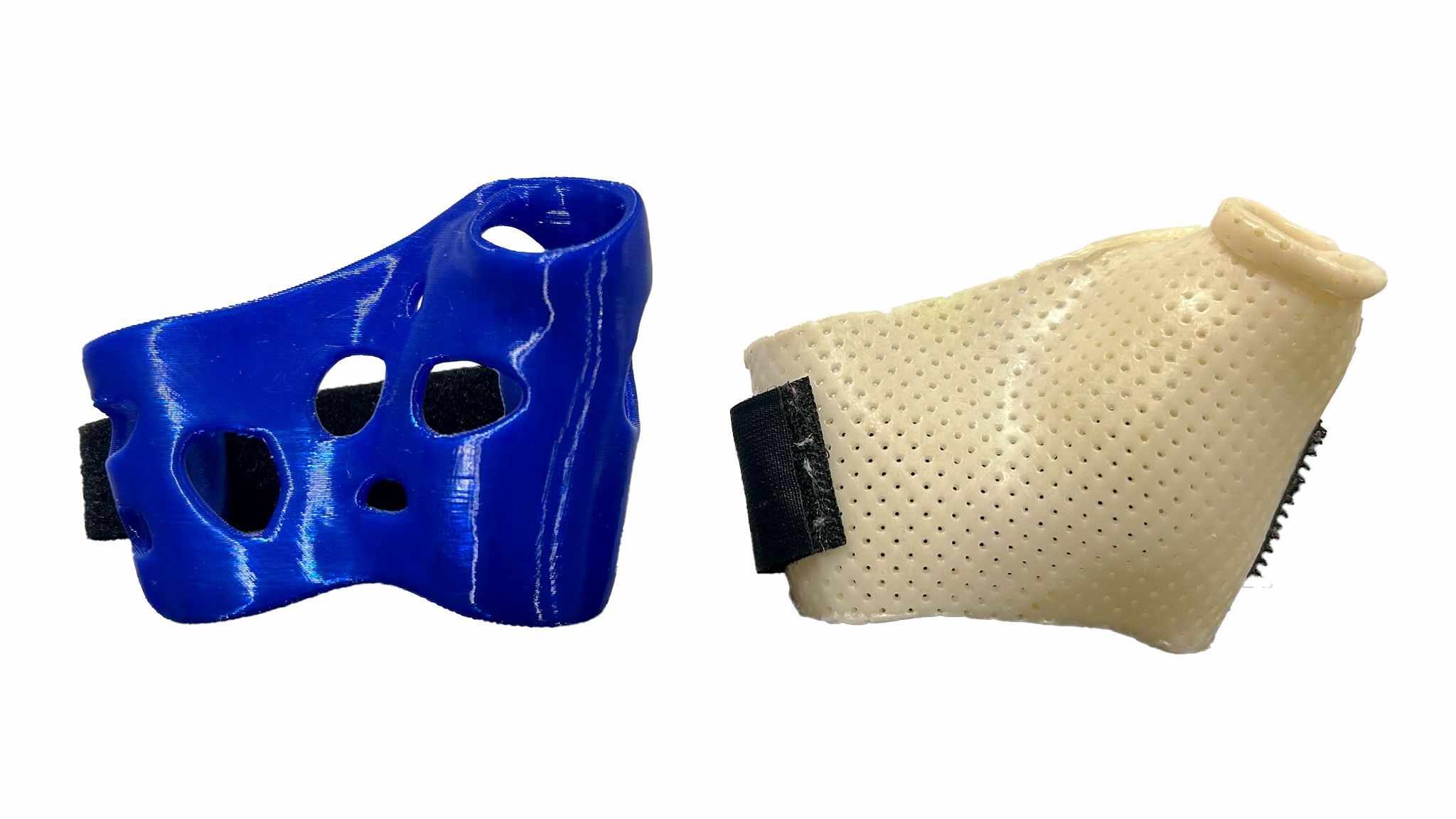
Most people are surprised to learn that hand therapists traditionally create custom splints by heating a flat sheet of thermoplastic and molding it directly onto the hand. As the material cools, it hardens into a rigid shape — which provides support but often feels firmer and less flexible, especially for painful or sensitive joints.
Thermoplastic sheets also come with pre-set perforation patterns, offering ventilation but little customization in hole size, placement, or breathability.
3D printing introduces a completely different design pathway — allowing for custom material softness, precise thickness control, and fully customizable perforation patterns matched to the patient's anatomy.
A modern alternative to heat-molded plastic — lightweight, breathable, and digitally engineered for comfort.
Splintech offers a curated palette of splint colors—designed to blend function with personal expression. Whether you prefer subtle neutrals or vibrant tones, each hue maintains the same ISO-certified quality and performance.
%20(1).jpg)
Traditional thermoplastic splints can often be molded in a single visit, which is convenient when time is the priority. 3D printing requires a two-visit process — one for scanning and one for fitting — because the splint is custom-designed and digitally engineered from a 3D model.
While this takes slightly longer, it enables a level of fit, comfort, breathability, and consistency that hand-molded materials cannot match. At Splintech, we prioritize quality and long-term outcomes over speed alone, because patients ultimately benefit most from a splint that feels better, lasts longer, and supports recovery with greater precision.
"A 3D-printed splint may be small, but it's the result of precise engineering and deep clinical knowledge—crafted for your comfort, function, and recovery." - Founder, Splintech
Your hands deserve precision, comfort, and care. Book a consultation today and discover your perfect fit.
Book a Free Consultation
Precision-crafted splints designed by a Certified Hand Therapist.

.svg)
